
Credit Card Statement Analyzer
Submit a credit card statement to inspect its balances, payments, purchases, credits, fees, interest, spending groups, possible recurring charges, and underlying entries. Start without an account or payment.
Preparing your private analysis
Your statement is being secured before analysis begins.
Leave this window open; your private results will load here when ready.
Upload your credit card statement
Credit cards use the same private workspace as bank statements. The analysis arranges balances, payments, credits, purchases, fees, interest, categories, recurring possibilities, and source entries for comparison with the original.
- No account or payment required
- One statement up to 20 MB
- Temporary results expire after 30 minutes
Credit card statement anatomy
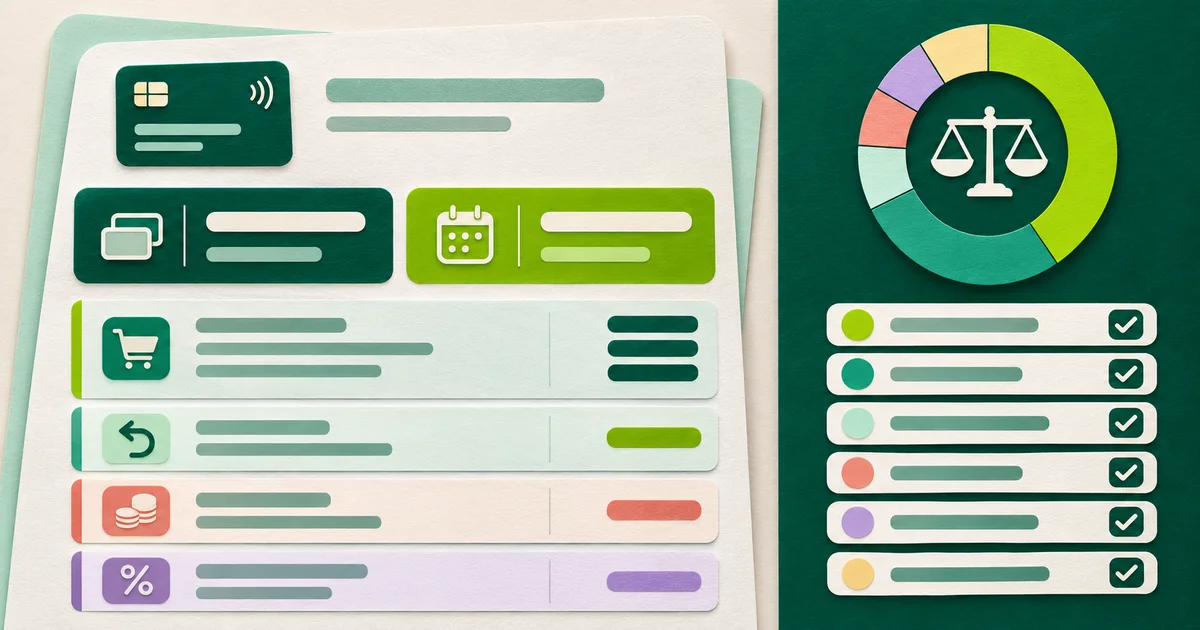
A credit card statement normally combines account and cycle identity, payment information, posted activity, fees and interest, available credit, rates, and issuer notices. Labels and placement differ, so use the document supplied by the issuer.
Identity and billing period
Check the named cardholder, masked identifier, period start and end, and the issuer's contact information.
Amount and due date
Find the closing balance, required minimum, due date, overdue figure, and any late-payment notice from the issuer.
Purchases and credits
Inspect posted purchases, advances, transferred balances, payments, merchant refunds, chargebacks, and other adjustments.
Fees and interest
Review annual, late, foreign-transaction, cash-advance, and transfer fees alongside interest for each balance type.
Limit and available credit
Set the credit limit beside the new balance and remaining credit, remembering that pending entries may be absent.
Rates and notices
Examine APR information, promotion end dates, interest-method disclosures, reward changes, and messages from the issuer.
Check how the new balance was built
Start with the previous balance, add purchases, advances, transfers, fees, and interest, then subtract payments and credits. The result should agree with the printed new balance after issuer-specific categories and signs are included.
Keep every payment-box figure in its proper role
Use the statement balance for the amount fixed at cycle close, the minimum payment for the smallest listed cycle payment, the current balance for later posted activity, and the due date for the issuer's stated payment deadline.
| Statement field | What it answers | What to verify |
|---|---|---|
| Statement balance | The balance fixed when the billing cycle closed. | Later activity normally does not change the issued statement. |
| Minimum payment | The smallest listed payment for the cycle. | A minimum-only payment may leave principal on which interest continues under the agreement. |
| Current balance | A live figure that may include activity posted after cycle close. | Use the issuer's live account screen to see exactly what it contains. |
| Payment due date | The issuer's stated deadline for the cycle payment. | Confirm cutoff time, processing time, weekends, time zone, and payment method with the issuer. |
Review every transaction as a complete row
Match the date, merchant descriptor, amount, currency, card suffix when shown, and any related credit or reversal. A familiar merchant name alone does not confirm the row.
- Distinguish purchase time from posting time.An item may arrive several days later or move into the following cycle.
- Interpret merchant wording cautiously.A descriptor might identify the processor, corporate parent, place, telephone number, or an abbreviated trading name.
- Reconcile each refund separately.Credits can appear in a later cycle under wording different from the purchase.
- Inspect foreign-currency entries.Set the original value beside the converted value, exchange details, and any separately listed foreign fee.
- Mark duplicates and unknown activity.Keep the complete entry and use a verified issuer channel whenever authorization is in doubt.
Trace fees and interest separately
Review each fee by type and triggering event, and each interest charge by balance category, APR, balance subject to interest, and calculation period. Different card balances can follow different rates and rules.
Interest charge
Record the balance type, relevant APR, interest-bearing amount, and calculation period. The issuer's agreement defines the actual method.
Account fee
Determine the kind of fee, what caused it, its value, and whether taxes or conversion appear elsewhere.
Promotional term
Note the promotional percentage, eligible balance, expiry, and subsequent rate. Never supply a term absent from the document.
If a charge is unfamiliar or incorrect
Keep the entire entry, consider ordinary merchant or authorized-user explanations, and then reach the issuer through a verified channel. Retain the case history. Applicable procedures come from the statement and card agreement.
Preserve the row
Capture the posting date, statement wording, value, currency, card ending, cycle, and any connected credit.
Check ordinary explanations
Consult authorized users, review receipts and messages, and compare statement wording with the merchant's public identity.
Contact the issuer securely
Call only a number printed on the card or statement, or published on the issuer's official site. Ignore details from unsolicited messages.
Track the case
Store the filing date, case reference, requested evidence, temporary credits, deadlines, and final decision in one record.
Credit card statement questions
These answers distinguish the issued billing-cycle record from live account figures and separate statement review from payment-software testing.
What is a credit card statement?
An issuer creates this periodic record for a card account. It presents cycle balances, payments, credits, purchases, fees, interest, payment details, credit limits, and activity.
How does a statement balance differ from today's balance?
Not always. A statement balance is captured when the cycle closes, while today's balance can include later postings.
What should I check first?
First verify the account and cycle. Next check the due date, required minimum, closing balance, overdue amount, and limit before moving to individual entries.
Does the generated card work for actual purchases?
No. It supplies documented sandbox data for payment-software tests, without any connection to active card accounts or actual money.
Looking for test-card data instead?
Choose test values documented by Stripe or Adyen, and examine explicitly fictional examples without typing an actual card number.