
Analyze the full statement
The free bank statement analyzer builds rows, organizes expenditure, and summarizes incoming funds, outgoing funds, and their net change.
Use focused bank statement tools to structure, inspect, analyze, and export data while retaining source evidence and clearly showing uncertainty.
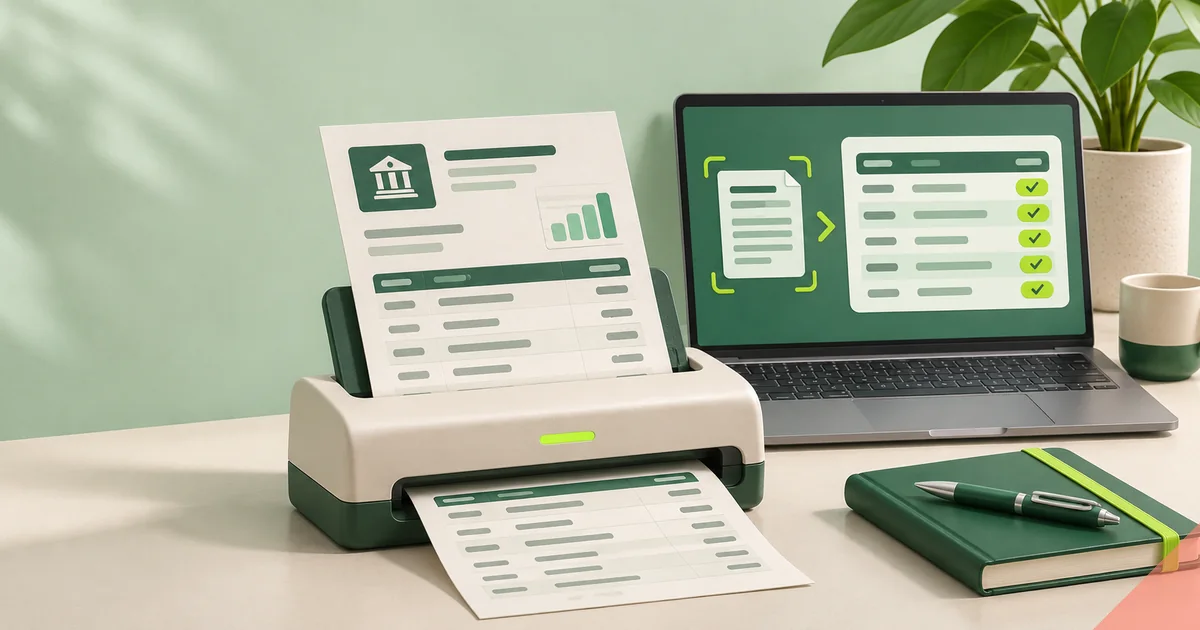
Choose the task that matches your goal. Tools retain bank wording next to standardized fields, alerts, and calculations so output can be checked against the document.
The free bank statement analyzer builds rows, organizes expenditure, and summarizes incoming funds, outgoing funds, and their net change.
For a workbook with review fields, select the bank statement to Excel converter. For straightforward imports, use the CSV converter.
The recurring payment finder evaluates wording, timing, and values. The cash flow summary tool traces movement across a statement period.
Choose one focused workflow. Each result keeps source descriptions and review limits visible.
Review a traceable ledger that separates extracted facts, calculated totals, suggested categories, recurring candidates, and unresolved data concerns.
The workbook keeps dates, source descriptions, debits, credits, balances, category suggestions, and confidence notes in distinct reviewable fields.
Move statement rows into spreadsheets, accounting software, or independent analysis while retaining a clear path back to the document.
After correcting orientation and dimensions, the reader rebuilds rows and marks unclear dates, figures, or balance sequences for inspection.
Potential matches come from aligned merchant labels, timing, and values, but each result stays unconfirmed until you check it.
Credits and debits remain separate, calculations link to their contributing rows, and failed balance checks stay visible.
Generate calculated fictional balances for practice or testing, with BANK-STATEMENT.NET permanently identifying the document as synthetic.
Check a processor-published test number with Luhn validation and study synthetic statement layouts without exposing genuine payment information.
Every tool preserves source evidence, exposes its arithmetic, and marks uncertainty so the output can be checked before it is used elsewhere.
Original statement descriptions remain beside normalized fields so a user can trace the output back to the document.
Totals and summaries identify the rows and arithmetic used instead of presenting an unexplained financial score.
Unreadable values, uncertain categories, incomplete pages, and inferred patterns remain marked for human review.
Even a tidy spreadsheet can hide OCR mistakes, reversed signs, absent pages, or doubtful categories. Consult the bank statement analysis methodology and apply the spreadsheet quality-control guide before an import or transfer.