
Bank Statement Spreadsheet Quality Checks
A workbook becomes reliable when every row can be traced to the statement. Its controls must demonstrate complete capture and make corrections visible.
Your statement is being secured before analysis begins.
Leave this window open; your private results will load here when ready.
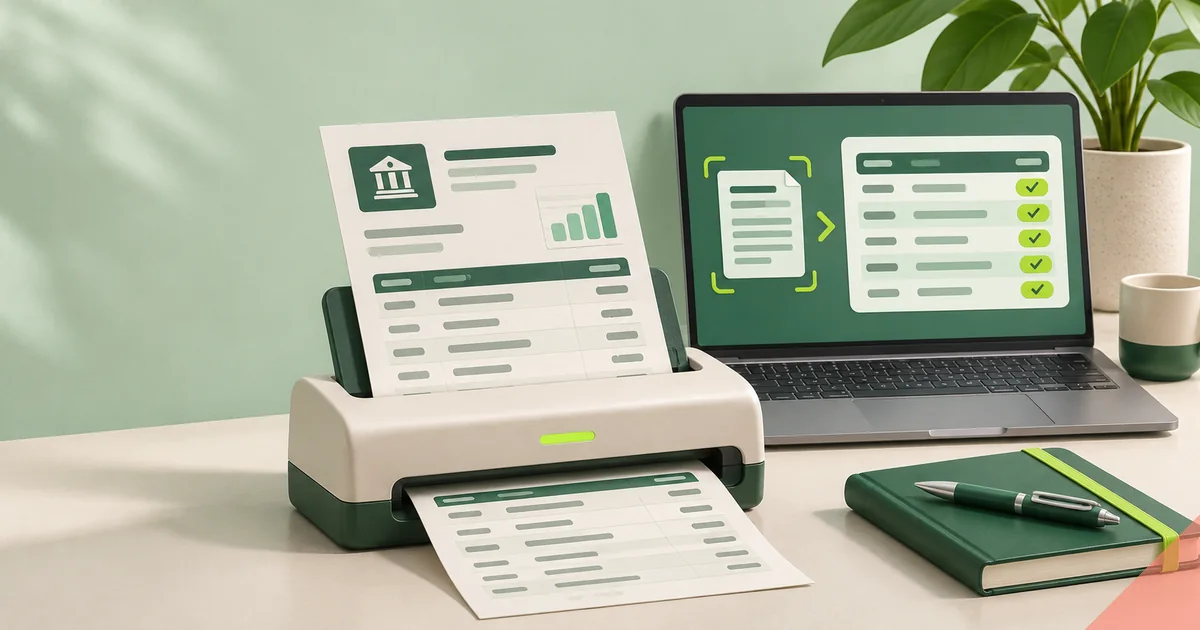
Convert the statement to an XLSX workbook containing an evidence-preserving transaction sheet and separate control summary. Review and reconcile it before categorization or reuse.
| Posted date | Original description | Debit | Credit | Balance | Review status |
|---|---|---|---|---|---|
| 2026-10-02 | Fictional payroll reference | 2,620.00 | 4,112.40 | Verify | |
| 2026-10-04 | Fictional housing payment | 1,450.00 | 2,662.40 | Verify |
Sample entries demonstrate column structure and do not come from an uploaded statement.
The Transactions sheet gives distinct fields to date, bank description, running balance, debit, credit, category, reviewer notes, and confidence. Separate debit and credit columns prevent an unverified sign convention from being imposed.
The Summary sheet documents account context, extracted totals, net change, row count, warnings, and the source-comparison requirement. It functions as a control record, not an independently issued bank document.
Preserve an unchanged export. Compare workbook rows with each statement page, total debit and credit separately, and prove that opening balance plus movement, including known fees, interest, and adjustments, reaches the closing balance.
Inspect for duplicate entries, imported page totals, wrapped descriptions turned into rows, and values displaced among debit, credit, and balance columns. Successful opening says nothing about structural correctness.
Suppose a statement has 42 transactions but the workbook has 43 because extraction treated a page subtotal as activity. The debit control exceeds the printed total by the same amount, so release must wait until that subtotal is excluded and controls are rerun.
Record the page location, extracted value, corrected classification, reviewer, and date in the correction log. This preserves a reproducible judgment instead of leaving an unexplained edit.
Place merchant normalization, category rules, transfer links, tax support, and bookkeeping references in added columns or sheets. Leave source descriptions, extracted values, page locations, and statuses untouched.
Before sharing, inspect copied financial data as well as metadata, comments, filters, and hidden sheets. Remove unnecessary content from a purpose-built copy and test the delivered file.
A workbook becomes reliable when every row can be traced to the statement. Its controls must demonstrate complete capture and make corrections visible.
Text volume does not establish OCR quality. Acceptance depends on proving that the reconstructed ledger retains the source rows, column positions, signs, and balance logic.
Begin analysis by producing a ledger that reconciles to the source. Categories and visual summaries become decision-ready only after row structure and amount direction have been checked.
See why source entries remain distinct from computed fields, confidence indicators, and reconciliation alerts.