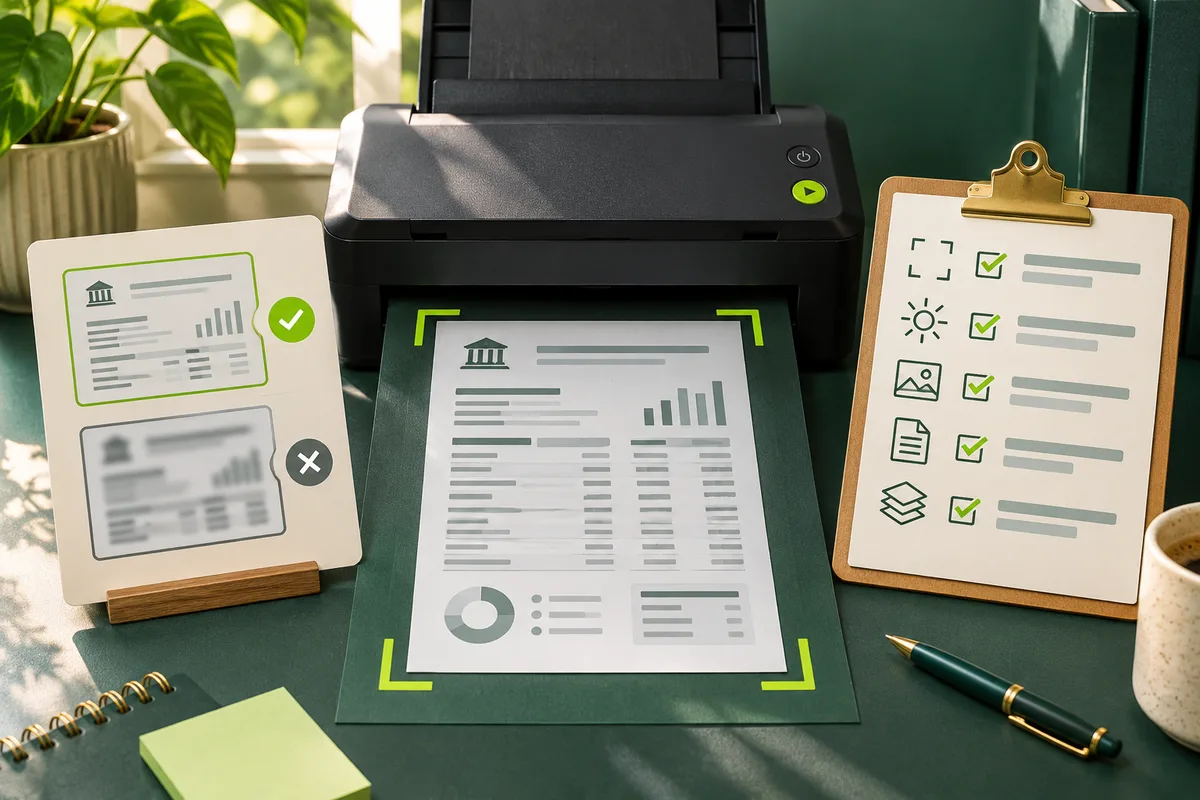
Text volume does not establish OCR quality. Acceptance depends on proving that the reconstructed ledger retains the source rows, column positions, signs, and balance logic.
This illustration uses imaginary information. Check actual statement details directly against the source.
Establish image quality before reviewing extracted text
Inventory all pages and verify orientation, sharpness, and readable scale. Inspect edges for cropping and note fingers, glare, shadows, folds, security patterns, or compression; a cropped margin may erase a value column even when descriptions look intact.
OCR acceptance record
Store the acceptance evidence beside the extraction so its limits remain visible to later reviewers.
Page coverage
List expected and received pages, orientation corrections, and every cropped or unreadable region.
Row sample
Trace the opening, middle, and closing transaction of each page to its image.
Arithmetic result
Preserve calculated and printed movement together with any difference that lacks an explanation.
Exception count
Count fields still under review and state whether they change totals or descriptive text only.
Test row and column reconstruction
On each page, trace at least its first, middle, and final transaction back to the image. Verify that dates remain attached to descriptions and that debit, credit, and balance figures have not shifted; wrapped descriptions often create false rows.
Use arithmetic as a detection tool
Rebuild movement from the opening balance through debits and credits, including interest, fees, and adjustments, then test several running balances. When a difference repeats from one row onward, that row is a strong candidate for the first sign or amount error.
Record uncertainty at field level
Confidence belongs at field level because a readable date and description can coexist with an uncertain amount. Attach the note to the affected field instead of declaring the entire document accurate or inaccurate.
For a source supplied as a scan or phone photograph, start with the bank statement image reader and keep every confidence warning beside the row it affects.
Begin analysis by producing a ledger that reconciles to the source. Categories and visual summaries become decision-ready only after row structure and amount direction have been checked.
A workbook becomes reliable when every row can be traced to the statement. Its controls must demonstrate complete capture and make corrections visible.