
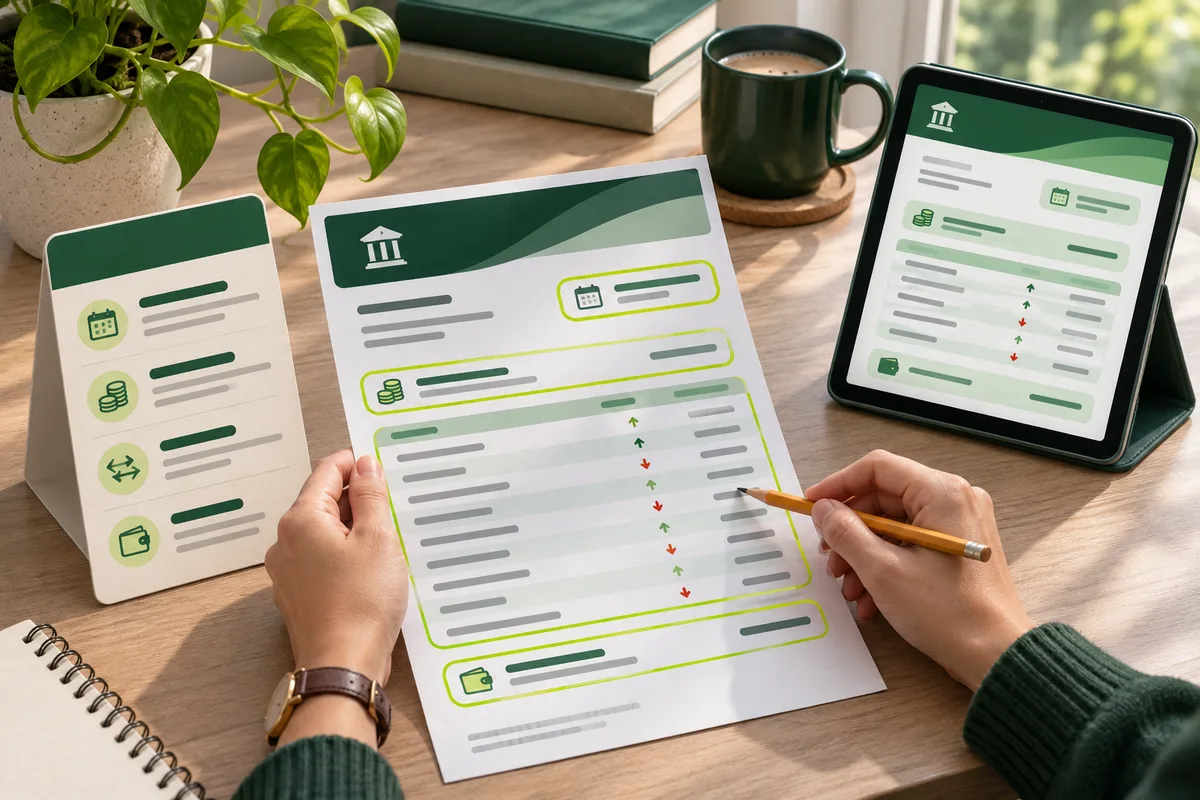
Establish which account and period the document represents
First locate the holder, partially hidden account identifier, covered dates, currency, and issuing institution. Entries around month end may fall into another statement because placement generally follows the posting date rather than the purchase date.
The opening figure begins the covered period; posted activity produces the closing figure. Since pending card entries may be absent, the live balance in an app can legitimately differ from the statement close.
Recalculate how the closing balance was reached
For a basic deposit account, test whether the opening balance plus credits, minus debits, with adjustments, equals the closing balance. Depending on the bank, credits may appear as deposits or incoming money, while debits may be withdrawals or outgoing money.
Suppose the period starts at $1,250, receives $2,100, pays $1,640, and incurs $10 in fees. The expected close is $1,700. A different result calls for checking interest, reversals, holds, and the statement's sign convention.
Work through one statement from printed controls to individual rows. If the opening balance is 2,430.00, posted credits are 3,275.40, posted debits are 3,018.65, and the statement shows 12.00 of fees outside the main purchase group, the expected closing balance is 2,674.75. Write down each component and its page reference. If the printed closing balance differs, stop before calculating spending. The missing amount can point to interest, an adjustment, a sign error, an omitted continuation page, or a transaction placed in the wrong amount column.
A ten-minute statement review
Complete these verification steps before the statement informs a budget, export, dispute, or disclosure.
Confirm the document
Verify that holder, masked account, currency, statement period, and total pages identify the record requested.
Recalculate movement
Test whether the opening balance, credits, debits, and adjustments reproduce the stated closing balance.
Scan high-risk rows
Inspect unknown activity, fees, cash withdrawals, returned payments, and unusual transfers before trusting category summaries.
Log unresolved items
Place the full entry and its page location in an exception log with an owner and next step.
Evaluate every transaction using its complete source row
Consider the date, unshortened description, amount, entry type, and running balance as one record. Merchant text by itself provides limited identification; locations, card endings, reference numbers, and payment channels may separate otherwise similar entries.
Wait to categorize until the row structure has been confirmed. Check column placement and signs first, standardize merchant identity second, and assign a category last. That sequence keeps displaced figures from turning into misleading spending conclusions.
Resolve unusual entries before relying on aggregate patterns
Before summarizing spending, inspect apparent duplicates, cash withdrawals, fees, returned items, transfers, and unknown merchants. Money passing between accounts you own represents movement and may be neither income nor expense.
For an unrecognized charge, retain the exact description and reach the institution through a verified channel. Bank-Statement.net can arrange the available record, but only the bank's process can address authorization or a dispute.
Prioritize exceptions by consequence rather than visual size. An unfamiliar 8.00 charge can require prompt account review even when a familiar 900.00 rent payment does not. A duplicated transfer can materially distort both income and spending even though the account balance still reconciles after both rows post. Record the reason each row matters, the evidence checked, and the next action. This produces a review queue that distinguishes account security, data quality, cash-flow interpretation, and ordinary categorization instead of treating every highlighted row as the same problem.
Verify the document first, then examine its transactions
Begin by proving that the statement is the intended record: check the account identity, reporting period, page sequence, and both endpoint balances. Review the ledger only after that coverage check, so an eye-catching transaction does not conceal a missing page or mismatched account.
Give every exception an actionable reason, such as an unknown merchant, suspected duplicate, unconfirmed transfer, questionable fee, amount mismatch, or absent support. Highlighting shows where you looked; a reason code shows what must be decided.
Create an evidence record for questions
For a questioned entry, capture its posting date, verbatim description, amount, direction, running balance, page location, and follow-up action. Preserve the issued file as evidence and place annotations or normalized names only in a separate working record.
Contact the institution through a number verified in its app, official website, or on the card. Provide the complete statement reference privately, without posting the document or transmitting it through an unverified route.
If current activity differs from the document, review the distinction between issued statements and live transaction records before treating an item as missing.
For demonstrations that must not expose real account data, create a synthetic bank statement generator sample and keep its fictional watermark visible.
Sources for this decision
Before following this reading path, confirm institutional, security, and recordkeeping rules in the cited authority.