
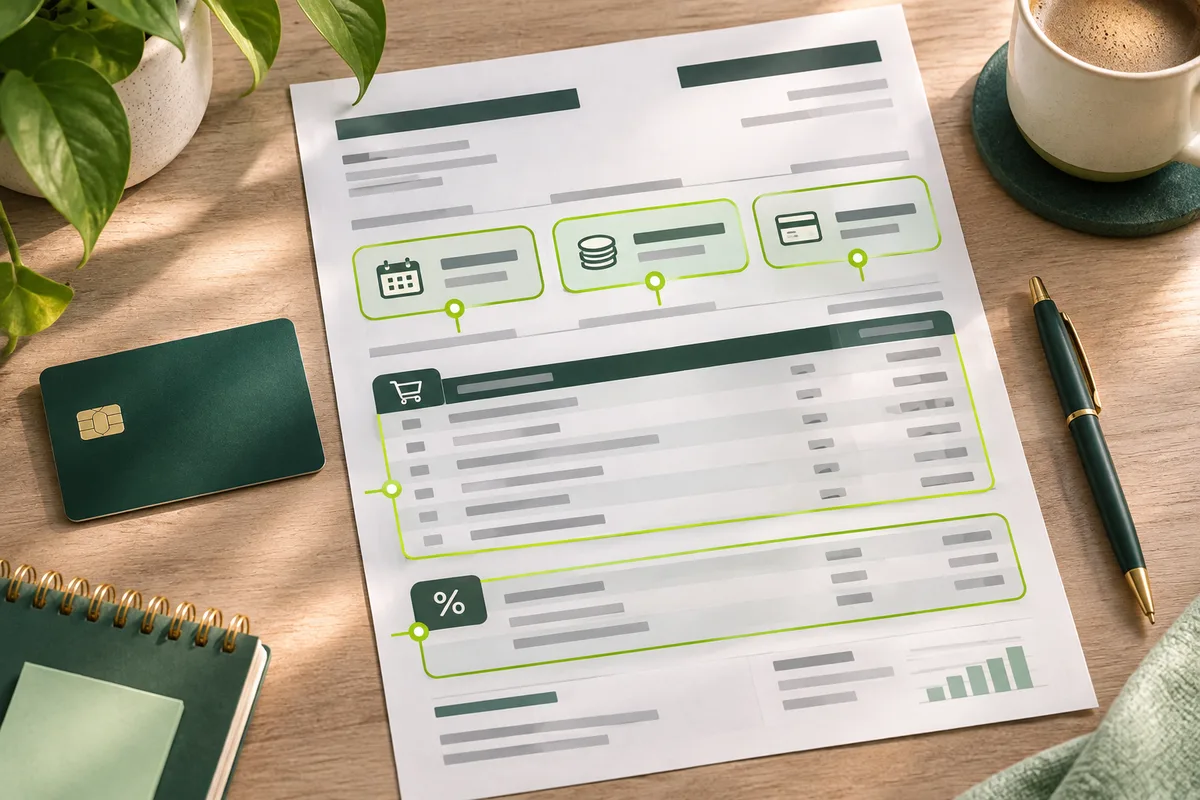
Establish the statement boundary
Confirm the cardholder or business name, masked account reference, billing-cycle opening and closing dates, page count, and currency before reading totals. The closing date controls which posted activity belongs to this statement. A purchase made near the cutoff can appear on a later statement when it remains pending until after the cycle closes.
Preserve the issued PDF or paper statement unchanged. If you add merchant labels, categories, or notes, place them in a separate review record. The issuer description and posting date are source evidence, while a normalized merchant name or spending category is an interpretation that can change.
A four-pass statement reading method
Use separate passes so one attractive total does not distract from a missing page, a payment problem, or a disputed transaction.
Identity and period
Record the masked account, billing-cycle dates, currency, page count, and statement issue date. Stop if the document is incomplete or belongs to a different card.
Balance bridge
Recalculate the previous balance through payments, credits, charges, fees, and interest. Record any difference without inserting an unexplained adjustment.
Payment control
Copy the due date, minimum, statement balance, past-due amount, and payment status into one dated checklist. Confirm the issuer's accepted payment method and cutoff.
Activity review
Mark unfamiliar charges, missing expected credits, duplicate-looking rows, new fees, and changed rates. Give every open item an owner, evidence source, and next action.
Rebuild the balance summary
Locate every component of the balance box: prior balance, payments, credits, purchases, advances, transfers, charges, interest, and the new balance. Recalculate the relationship using the signs printed by the issuer. A common structure is previous balance minus payments and credits plus new charges, fees, and interest equals the new balance, but the statement itself controls the labels and treatment.
Do not mix the statement balance with a live current balance from the issuer app. The live amount can include posted activity after the closing date. Record both amounts with their timestamps if you need to explain the difference, then build a bridge from the closed statement to later posted transactions.
Rebuild the balance summary with the issuer's exact categories. In a fictional example, a previous balance of 1,040.00 minus 600.00 of payments and 40.00 of credits, plus 720.00 of purchases, 12.00 of fees, and 18.00 of interest produces a new balance of 1,150.00. Tie every component to the transaction list or statement summary. If the equation does not close, inspect cash advances, balance transfers, returned payments, adjustments, and items listed outside the main purchase table before relying on utilization or spending totals.
Read the payment information as a dated instruction
Identify the payment due date, minimum payment due, new balance, past-due amount, and any issuer warning or estimate. Treat each field separately. The minimum is the smallest listed payment for that statement, while the statement balance is the closed-cycle amount. Paying one does not mean the other has been paid.
Check the issuer's current payment instructions for cutoff time, accepted method, and processing rules. A scheduled payment, a submitted payment, and a posted payment are different states. Keep the confirmation reference when timing matters, and verify the account after the payment posts rather than relying only on a calendar reminder.
Read the payment box as a set of separate controls. Record statement closing date, payment due date, minimum payment, statement or new balance, past-due amount, and any issuer notice. Then distinguish an automatic payment setting from a payment that is scheduled, submitted, processing, or posted. Save the confirmation and verify final application through the issuer. A reminder or bank-side withdrawal alone does not prove that the card account applied the intended amount by the relevant time.
Trace transactions, fees, interest, and notices
Review purchases, credits, payments, fees, cash advances, balance transfers, and interest in their own groups. Compare unfamiliar entries with receipts, merchant accounts, authorized users, digital wallets, and the complete statement description. Match refunds to the original purchase instead of treating every credit as income.
Read rate tables, fee summaries, rewards adjustments, change notices, and messages even when the transaction list looks correct. These sections can explain why interest appeared, why a promotional rate changed, or why a reward total differs. Consequential decisions should be checked against the card agreement and current issuer instructions.
For training or interface testing without customer data, create a fictional credit card statement sample and keep its sample watermark visible.
For a closer review of the payment box, use the minimum payment and due date guide before scheduling a payment.
Sources for this decision
Before following this reading path, confirm institutional, security, and recordkeeping rules in the cited authority.