
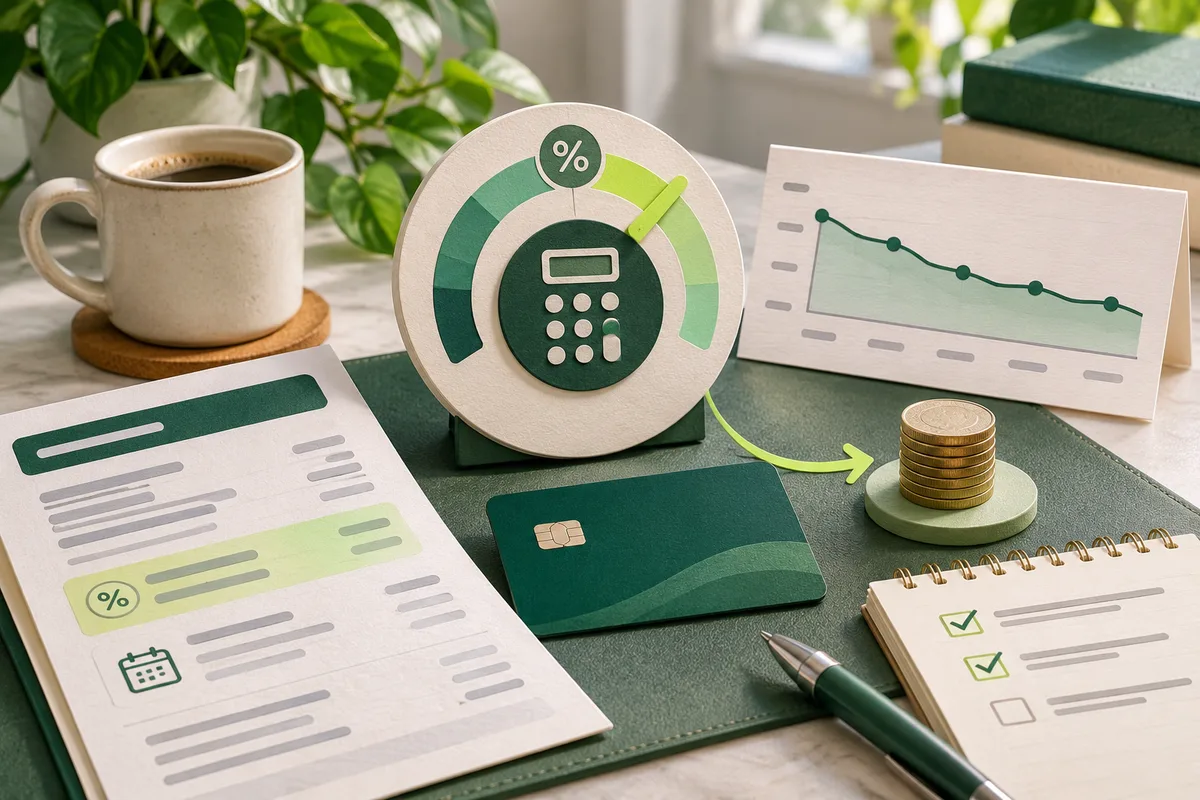
Map each balance to its rate category
Locate the interest-charge calculation or rate table and list each category separately: purchases, cash advances, balance transfers, promotional balances, and any penalty category shown. Record the annual percentage rate, balance subject to interest, interest charge, and any expiration or variable-rate note for each line.
Do not average unlike categories into one rate. A payment can be allocated under account terms and applicable rules, while new transactions can enter different categories. The statement and agreement provide the relevant method; a blended estimate is useful only as a rough reasonableness check and should be labeled as such.
Identify the issuer's calculation method
Read the statement explanation and card agreement for the balance method, daily or periodic rate, number of days, compounding treatment, grace-period conditions, and transaction timing. Average daily balance methods require daily movement, not just the opening and closing balance. A purchase posted mid-cycle does not carry the same number of days as one posted on the first day.
Convert rates only for a reasonableness test and retain sufficient precision until the final comparison. Rounding an annual rate too early, assuming 30 days, or applying one rate to the closing balance can create a difference that looks like an issuer error but comes from the reviewer's method.
Test a small interval before projecting an entire cycle. A 1,200 purchase balance held 10 days at 24 percent APR has a simple daily estimate of 1,200 times 0.24 divided by 365 times 10, about 7.89 before issuer rounding or compounding. Compare this bounded result with the issuer's method and balance category, keeping purchases, cash advances, transfers, and promotions under their separate terms.
Test one bounded interval before reconstructing a full cycle. A simple reasonableness estimate for a 1,200.00 purchase balance held for 10 days at a 24 percent annual rate is 1,200 multiplied by 0.24 divided by 365 multiplied by 10, or about 7.89 before issuer rounding, compounding, and transaction-timing rules. The figure is not the official charge. Compare it only with the correct balance category and disclosed method, and retain enough precision to keep rounding from becoming the apparent difference.
Reconstruct a bounded estimate
Create a daily timeline for one rate category. Start with the prior daily balance, apply posted purchases, payments, credits, fees, and adjustments on the dates the issuer method uses, then calculate the daily balance or other required base. Sum or average according to the disclosed method and apply the relevant periodic rate.
Keep fees separate unless the agreement states how they affect the interest calculation. Compare the estimate with the statement charge and record the rounding convention. The goal is to locate a meaningful unexplained difference, not to replace the issuer's official calculation with an undocumented spreadsheet.
Build a daily timeline when the issuer uses a daily-balance method. Start with the applicable category balance, apply posted purchases, payments, credits, fees, and adjustments on the dates required by the agreement, and record the daily result. Keep purchase, advance, transfer, promotional, and penalty categories separate. If the estimate still differs, test cycle-day count, variable-rate date, promotion expiry, payment allocation, grace-period status, and residual interest before concluding that the statement charge cannot be explained.
Interest review worksheet
A category-by-category worksheet makes assumptions visible and prevents one APR from being applied to every balance.
Rate inventory
List every balance category, APR, periodic rate if shown, balance subject to interest, charge, and promotional or variable-rate note.
Method evidence
Quote the issuer's balance method, posting-date rule, cycle-day count, compounding treatment, and relevant agreement section.
Daily reconstruction
Build one dated balance timeline for the questioned category and retain full precision until the final statement-level comparison.
Difference log
Record the issuer charge, calculated estimate, exact difference, likely timing or rounding explanations, and the evidence needed to close the issue.
Explain differences before escalating
Check the posting date used, cycle-day count, variable-rate effective date, promotional expiration, residual interest, new transactions, payment allocation, cash advances, returns, and previous adjustments. A zero purchase interest charge can reflect a grace period, while another category still accrues interest under different terms.
If the calculation still cannot be explained, preserve the statement, agreement version, daily timeline, rate table, and exact difference. Ask the issuer for the calculation through an official channel. Do not state that an interest charge is wrong until the method and complete activity have been compared.